
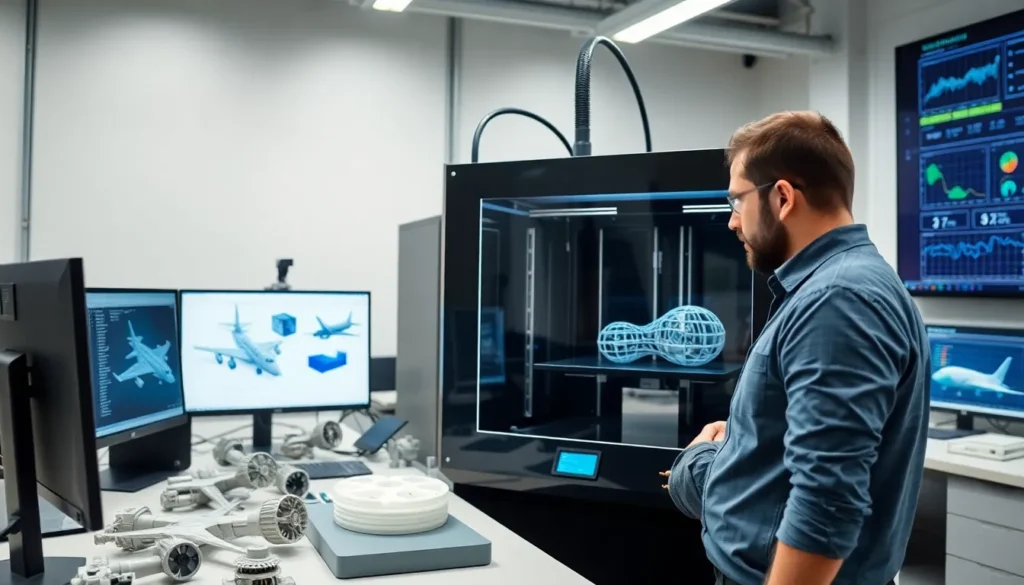
Imagine a world where airplanes can be built faster, lighter, and more efficiently. Sounds like sci-fi, right? Well, welcome to the reality of 3D printing in aerospace. This groundbreaking technology is not just for your average hobbyist: it’s transforming the entire aerospace industry. In this text, we’ll jump into the nitty-gritty of how 3D printing is revolutionizing aeronautics, the benefits it brings, and what the future holds. Buckle up.
Overview of 3D Printing Technology
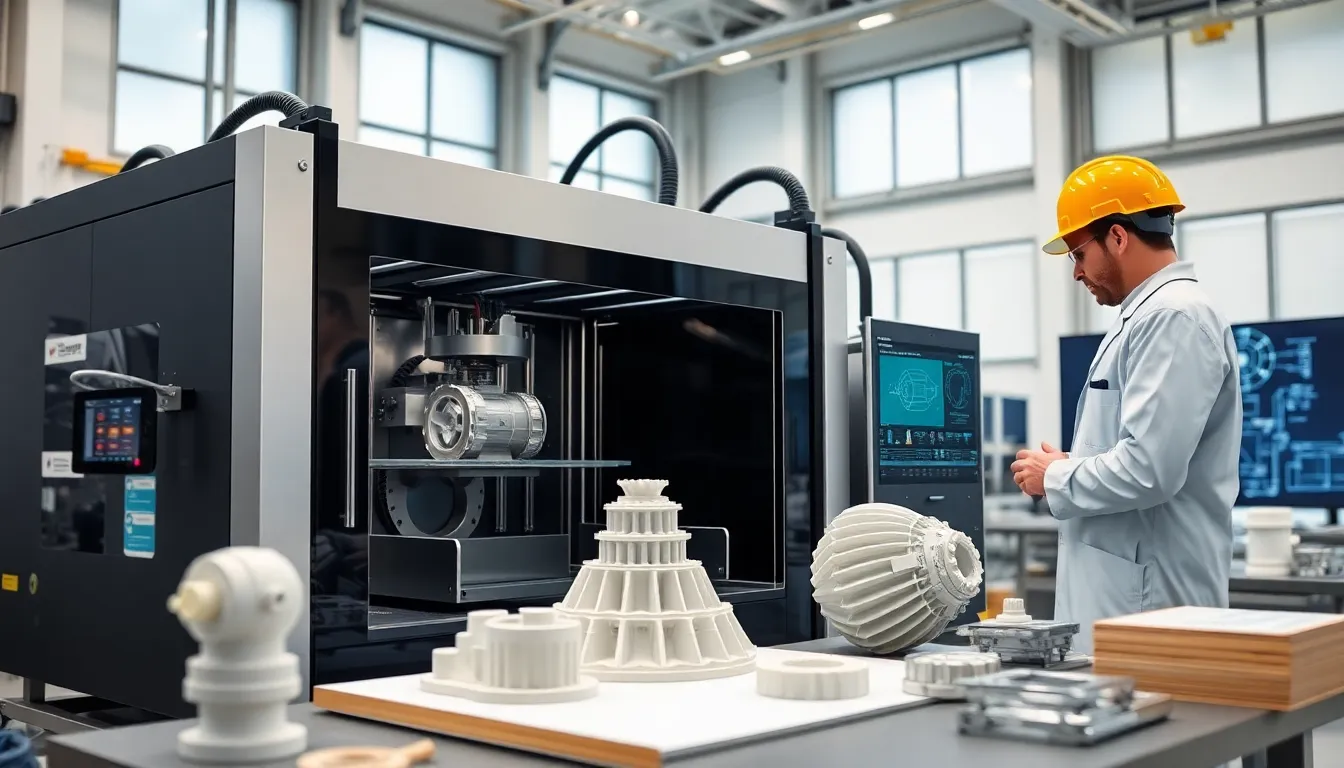
3D printing, also known as additive manufacturing, has come a long way since its inception. At its core, this technology creates three-dimensional objects from digital files by layering materials one at a time. This process stands in stark contrast to traditional manufacturing methods, which often involve cutting away material to create an object. Key techniques involve fused deposition modeling (FDM), stereolithography (SLA), and selective laser sintering (SLS), each with unique applications. While manufacturers initially experimented with prototyping and small parts, the aerospace sector is now harnessing 3D printing for substantial components, pushing the boundaries of what’s possible.
Benefits of 3D Printing in Aerospace
The advantages of implementing 3D printing in aerospace are impressive and multifaceted. First and foremost, the ability to produce lightweight components translates to increased fuel efficiency. Every gram counts in aviation, and reducing weight without sacrificing structural integrity can lead to significant cost savings on fuel. Besides, 3D printing significantly cuts down production time. Gone are the days of waiting weeks or months for parts: with 3D printing, prototypes can be created within days. Another boon is customization. Aerospace engineers can tailor parts to meet precise specifications without incurring exorbitant costs. Also, 3D printing is more environmentally friendly, producing less waste compared to traditional subtractive methods.
Key Applications of 3D Printing in Aerospace
3D printing has found its way into many areas of aerospace. One prominent application is in the production of engine components. Companies often use 3D printed fuel nozzles that can withstand high temperatures and pressures, improving combustion efficiency. Also, interior cabin fixtures are another hot spot for 3D printing. Airlines now create custom seating designs that enhance passenger comfort while optimizing space. Spare parts manufacturing has also undergone a revolution: rather than storing a warehouse full of parts, companies can produce them on demand. Finally, 3D printing is proving invaluable in R&D. Engineers can quickly test new concepts without the financial burden of traditional manufacturing.
Materials Used in Aerospace 3D Printing
A variety of materials lend themselves well to aerospace 3D printing. Common choices include titanium, aluminum, and high-performance polymers. Titanium, treasured for its exceptional strength-to-weight ratio, is ideal for producing critical structural components. Aluminum alloys, on the other hand, are used extensively for their lightweight yet robust characteristics, making them perfect for a range of applications from airframes to engine components. High-performance polymers, such as polyether ether ketone (PEEK), offer thermal stability and are used for specialized components that might face extreme conditions. Each material brings its unique properties, enabling engineers to select the best material based on application requirements.
Challenges and Limitations
Even though its many advantages, 3D printing in aerospace is not without hurdles. One major challenge is regulatory compliance. The aerospace industry is heavily regulated, and ensuring that 3D printed parts meet all safety standards can be a complex process. There’s also the issue of material properties. While many materials are suitable for lightweight applications, ensuring they meet high performance and reliability standards over time is critical. Also, there are concerns around scalability: while 3D printing excels in small-batch production, scaling to meet the vast demands of commercial aviation can be tricky. Finally, the technology still needs to reach maturity in some aspects, with issues around print defects and quality assurance needing further attention.
Future Trends in Aerospace 3D Printing
The future of 3D printing in aerospace looks incredibly promising. Innovations in metal 3D printing could lead to even stronger and lighter materials, unlocking new possibilities for aircraft design. More companies are expected to invest in this technology, with a focus on integrating artificial intelligence and machine learning to improve design processes and streamline production. The rise of bioprinting is another fascinating trend. Imagine the possibility of creating living tissues for space missions. Also, advancements in recycling materials for 3D printing will make aerospace practices even more sustainable, promoting a closed-loop production model. As research advances, expect to see 3D printing becoming a standard operation in aerospace manufacturing.


